Thanks for stopping by my blog my little slice of cyber space. Please leave a message so I know you have been here and so I can also pay you a visit too!

Showing posts with label De-clutter. Show all posts

Monday, January 04, 2016

Organization and de-cluttering--- it is what is happening in 2016

I joined a group that gives specific items to organize each week, I have condensed the list and articles to a more manageable level.
Join = https://www.facebook.com/groups/declutter365/
Week #1 Organized Home Challenge
Kitchen Organization: Countertops & Sink

This week's challenge is all about kitchen organization, both overall and with specific emphasis on keeping your countertops and sink clear and clean. The reason I chose this challenge as the first of the year is because keeping your kitchen organized (and functional) is so important to keeping our whole house running smoothly, and can have such a positive impact in our lives.
Step 1: Think About The Functions Of Your Kitchen  Before we dive in to action for the kitchen organization challenge, let's make sure we're headed in the right direction to best suit the needs of our home and family as we organize. That means we need to consider how we currently use our kitchen, either intentionally or unintentionally, and how we want to use it in the future.
Common Functions In Kitchens  There are both obvious functions of a kitchen, and the sometimes unintended functions of a kitchen, because of its central location as a hub of family life. Here are some of the most common uses and functions. See which ones you use yours for: Cooking (also including food preparation)     Food storage (both cold storage and pantry) Recipe and cookbook storage     Home recycling center  Place we drop stuff as it comes in the house, from paper clutter, such as bills, homework, school papers, etc. to keys, and whatever else we have in our hands as we walk in the door

Step 2: Create Useable Counter Space And Clear Your Kitchen Table (Mostly)
Once you've decided how you want to use your kitchen you can begin taking action to meet those goals, and to take control of the space.  This week in the kitchen organization challenge we'll focus on counter space and keeping your sink clear, and focus on other areas later in the challenge. (If you're interested check at the bottom of the page for a sneak peek for the upcoming weeks' challenges related to the kitchen).

Why Clear Counters Are So Important
There are two main reasons why keeping your counters (mainly) clear is so important to home organization.  The first is that you need clear counter space to do many different cooking activities. Since this is the primary function of a kitchen you need space to do these tasks. The second is more of a mental reason. Seeing clear space, instead of cluttered space, is just much more calming and can keep you from feeling so stressed when you enter the room.

Declutter Or Put Away Stuff On Your Counters That Does Not Fit Your Kitchen's Functions
Once you've decided what the functions of your kitchen and its counters you can remove any items that don't fit those functions.

Harder Task: Decluttering And Putting Away Items On Your Counter That Do Fit Your Kitchen's Functions
These are the types of items where you need to start really thinking about how often you use them, to know if they deserve a spot on the counter or not. Definitely, if you have room, keep out appliances that you use daily, like a coffee maker or toaster (if you truly use them daily). Depending on the size of your kitchen, you may even decide you have enough room to keep out appliances you use on a weekly basis.

However, anything you don't use at least weekly should not be on your counter top. Instead, it should be put away somewhere else, perhaps in a cabinet in your kitchen, or in a storage area if you only use it once a year.
The rule to remember for kitchen organization, or really any organization for that matter, is that the more frequently you use something the easier it should be to get to. The converse is also true, so if you use it infrequently, don't let it take up prime real estate in your storage areas.

Declutter The Following Types Of Gadgets And Appliances
Some kitchen gadgets and small appliances shouldn't be stored at all, but instead should just be decluttered all together. Here's some simple guidelines to follow, to know when to just throw it away (or donate it to charity).

Too old    Broken  You have duplicates  You know you'll just never use it again (or haven't used it in the last year, at least)
Make It A Habit To Declutter & Clear Your Kitchen Table Daily

The solution: daily take a few minutes and clear your kitchen table of previous activities so it is ready for the next meal, the next family board game night, to tackle the math homework, or whatever else.
Step 3: Consider These Kitchen Storage Solutions To Help Clear Counter Space

Sometimes it is helpful, as a part of your kitchen organization project, to have some items out of drawers or cabinets, such as frequently used pots and pans, or kitchen utensils, but you don't want them to take up too much counter space. Here are some kitchen storage solutions and ideas to consider to keep your counters free of clutter, and still have access to frequently used items:
Rails, racks and hooks to hang pots and pans (such as from the ceiling) or utensils (from the wall)

Knife block or magnetic knife storage for the wall  Decorative utensil crock or holder to hold utensils close to stove
Step 4: Create The Habit Of Keeping Your Sink Clear Of Dishes At Least Two Times Per Day

The other part of this kitchen organization challenge that goes along with clearing your countertops, is to begin or stick with the habit of keeping your sink clear of dirty dishes, at least most of the time.
*****My notes - keeping the sink area clean is a major focus this year and not leaving dirty dishes in the sink each night that way going into the kitchen to cook isn't so hard because I don't have to clean before I cook.
Items to put away because they are not used daily even weekly - mixer, blender, spice rack, steamer
Spice rack is now gone and the spices are all cleaned out and ready for a new year.
Steamer has a new home. I know where I want to out the mixer and the blender however I have to clean those cupboards first.

Monday, January 19, 2015

DECLUTTER - that is the name of the game Jan 19

It's Monday morning, and that means it's a new week in the 52 Week Organized Home Challenge. In Week #3 we're organizing the pantry and spices. And when I use the term "pantry" I am using it to include food storage areas, even if you don't have a space in your home dedicated as a pantry. So no one is excluded from this challenge! Today's mission is to read the instructions for this week's challenge and get yourself a game plan for how you'll tackle this organization project this week, while we continue to declutter our homes. This challenge, along with the next few, will all lead you to be able to save yourself time with meal prep and planning, and also money by using the food you've already purchased. So let's get organized together in 2015!
Full article click here

Step 1: Declutter And Get Rid Of Expired Food Items

The first step in the Organize Pantry Challenge is to declutter your food storage areas, getting rid of things that don't belong in them and also getting rid of expired or old food, or food you know you and your family will not eat.

To do this step take everything out of the pantry or other food storage areas (and if you've got multiple places you've been storing stuff this is even more important) and look at each item, making a decision of whether to toss it or keep it. (If the item is unopened and not expired, but you know you'll never eat it please donate it to a food pantry.)
 
If, when you do this step you realize you have a lot of food to eat, I suggest participating in the Eat From The Pantry & Freezer Challenge over the next two weeks, while you're simultaneously organizing your pantry and then next week.

Optional And Mandatory Cleaning Up While Shelves Are Empty

While everything is off the shelves it may also be a good time to sweep or vacuum up in the pantry, reline shelves, or otherwise clean up spills and messes that may have occurred in your food storage areas.
Spills and drips will attract pests, so make sure to clean these up, so this is mandatory. On the other hand, prettying up your shelves is not necessary so only do it if you've got time and energy, so that part is optional.

Step 2: Categorize What You've Got Left

The next step in the Organize Pantry challenge is to categorize the food that you've got left. Here are some common major categories, but you should categorize things the way they make sense to you, and also depending on what your family likes to cook and eat.
  • Dry goods, such as flour, sugar, etc.
  • Canned goods, and jars
  • Dried food, such as pasta, rice, beans and grains
  • Boxed items, such as cereal and crackers, and also mixes
  • Spices
  • Beverages (not yet in the refrigerator)
  • Root vegetables, such as potatoes and onions which are not stored in the refrigerator or freezer

Once you categorize everything and place like items together you may realize you have several duplicates of certain items. That is fine if you will use them before they go bad, but you may also realize you've got way too much of a particular item and can get rid of even more.

Step 3: Make A Pantry Inventory So You Know What You've Got From Now On


The next step in the Organize Pantry Challenge is to use the pantry list I've created (or one you create yourself) to inventory the food you've got left.
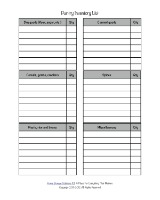
pantry listIf you've kept the food and haven't gotten rid of it in one of the steps above, then I am presuming that you actually plan to eat this food at some point before it goes bad. To make sure you do that create an inventory system so you can plan meals to use these ingredients.
In addition, using a list like this from now on will keep you organized in the future because you will not run out of staple items anymore. If you use an item regularly, and it has a long shelf life, your goal should be to have at least two of them at all times in your home. The one in use and the one ready to be used as soon as you finish the other. When you get the spare make sure to write down on your grocery list to pick up another at the store. You'll never run out of staples this way!
Obviously, not everything is a good candidate for this system, such as things which go bad quickly. However, it is a wonderful system for certain non-perishables, and not only food but also for items like toiletries and paper supplies, such as paper towels and toilet paper.
I provided a bit more instruction on how to use this pantry inventory on the page itself which contains this free printable, so be sure to read that when you print out your sheet.
Please note I don't want you to get too caught up on the inventory, and making a very meticulous list. Instead, go with broad categories and provide only as much detail as necessary to make it useful and functional, instead of getting bogged down counting grains of rice. Your goal is to organize pantry space, so don't lose sight of that.

Step 4: Organize And Containerize Your Food

Now that you've got everything categorized and inventoried, now is the time in the Organize Pantry Challenge where you put everything back away in your pantry or other food storage space(s).
If you can put everything together in one space that's great, such as if you've got a walk-in pantry, but if you've got to spread things out throughout the house because of lack of large amounts of central storage space in your kitchen that's fine too. Just make sure you choose cool dry areas, and not those which have wide temperature variations since this will cause food to spoil much more quickly.

Group Items By Category Within Your Pantry

Just like with the Kitchen Cabinet Organization Challenge last week, when we considered the "zones" in our kitchens, we need to consider that same issue this week during the Organize Pantry Challenge.
If you've got tall pantry shelves use expandable shelves to make more room for storage 
Think about the zones in your pantry, and what can go where. I suggest grouping items in your pantry, to the extent possible, in the same way you categorized them earlier in the challenge. This will generally keep like items together, making things easy to find and get to when needed.
Try to place bulky items at mid-height for ease of getting them off the shelves. Place lighter items up high, where they are easy to get off shelves without fear of falling and hurting anything, and cans and jars at a mid to lower level. Obviously, the things you use most frequently need to be given the easiest access.
If you've got extra space in your pantry after placing all your food in there, you can use some of the extra room to hold seldom used appliances, pots and pans, etc., such as on high shelves to clear counter and cabinet space.

Location Of Snacks In Homes With Kids

The one thing I recommend being in a category by itself are snacks, especially if you've got kids. Where you place your snacks in your pantry, as part of the Organize Pantry Challenge, really depends on your family situation. If you've got young kids you may want to place snacks up high where they can't reach them.
On the other hand, perhaps you have older, trustworthy kids. In that case you may want a bin of healthy snacks within easy reach to encourage healthy snacking, and only have the occasional less-healthy treats in a more out of the way location. This allows you to let them help themselves without you having to assist every single time they want something. You decide what works best for your family.

Containerize Much Of Your Food For Beauty, Function And Controlling Pests

We've all seen pictures of beautiful pantries with all the food in storage canisters or other containers and drooled just a little. If you're interested in seeing some awesome pantries from around the web check out my pantry organization board on Pinterest. Your pantry doesn't have to look that beautiful to be functional, but I am a HUGE fan of containers for much of your food.
The reason you don't want open food containers in your pantry is because they attract pests, such as insects and rodents. Trust me, I live a stone's throw from corn fields -- mice love open food containers, or even closed boxes and packages that aren't sealed up.
Because of the "mouse incident" in our house a few years ago I'm probably more of a stickler for this than some, but we keep all the food we can in plastic bins, with lids on them, to deter pests. I just group things into categories and it keeps things organized and safe at the same time. If you aren't as concerned about pests in your area you still may want to consider storage baskets for grouping like items together as part of the Organize Pantry Challenge just to keep things together and easily accessible.
I will note, however, that root vegetables, such as potatoes and onions need to "breathe" so you can't put them in a closed container.

Labels Are Your Friends

A label maker can help you neatly organize  many areas of your home 
Whether you containerize or not in your pantry, labels are your friend. Part of the Organize Pantry Challenge, therefore, is to label either the containers or the shelves of your pantry to help with storage and organization. You can use either a label maker, such as the one shown on the right, a permanent marker, or get crafty with it, whatever you have time and desire to do.
First, labels are important if you take things out of the package so there is no doubt what you've got in there. You don't want to mistake salt for sugar, or baking soda for baking powder, for instance.
Please note if you take things out of their package for storage you may want to note somewhere the expiration or use by date for the food product too, so you use it before it goes bad, or know when to throw it out.
Second, labeling shelves or containers holding a category of items is an excellent way to make sure it is easy for you (and other family members) to put things away in the right place, or find something again easily. After thr Organize Pantry Challenge is completed the goal is for you to be able to have any family member unload the groceries into the pantry without assistance, because the labels will tell them where to put things.

Follow The Last In, Last Out Rule

A can rack is a simple way to easily follow the last in, last out rule 
Make sure when you're doing the Organize Pantry Challenge that you place things in your pantry in such a way that you're following the last in, last out rule. This is important for all foods, but especially is a good rule for canned and jarred foods.
The best way to explain this rule is with an example. When putting away jarred spaghetti sauce from the grocery store place the newly purchased jars at the back of the section of pasta sauces, moving the older jars closer to the front. Then, when you're ready to use one just grab the one up front.
This method makes sure you always use up the older food first, and don't leave one jar of sauce lingering so long in the back of the pantry that it expires before you ever use it.
Please note that if you use a lot of canned goods, a can organizer (such as the one shown to the left) will naturally help you use this rule by the way it is designed to load cans.
Also, if you do have lots of canned food, check out these can storage ideas and solutions.

Spice Storage And Organization

Lots of people get a bit carried away, in my opinion, with organzing their spices. There are many cute and awesome looking spice racks and organizers available that can make us feel like we're Alton Brown or another gourmet cook, but they shouldn't be a high priority if you've got lots of other organizing to do first, unless you use your spices all the time.
The important thing, whether you splurge on a spice organizer now or not, is to keep your spices in well labeled airtight jars or tins, and keep them where they're handy (but not too close to the heat). Further, unless you use a lot of a particular spice quickly, then it is best to buy your spices in small amounts, even if the cost per unit is higher, since they tend to lose flavor quickly and need to be replaced often.
A simple spice rack or a drawer for your spices may be all you really need. Truly consider how many spices you have, and don't buy or use something either too big or too small for the amount of spice containers you truly use, on a regular basis.
You can get more ideas in the organizing and storing spaces hall of fame where readers share how they've done it in their own homes.

Step 5: Consider These Pantry, Spice And Food Storage Solutions

When you're doing step 4 of the Organize Pantry Challenge consider some of these pantry storage solutions to help you get the job done. Which ones will work best for you depend on your kitchen's layout, your personal preferences, and what your family eats and cooks on a regular basis.
  • Plastic or glass caninsters with locking lids, and seals to keep in freshness (ideally clear to see contents inside)
  • Stainless steel lazy SusanStorage baskets or tubs, with or without lids
  • Can organizers (such as the one suggested above)
  • Lazy susans or turntables (see to the right)
  • Plastic bins to group like items (nice if they are pull out, but not necessary)
  • Spice racks or organizers (many varieties, such as for the wall, over the door, cabinet, shelves, magnetic, etc.)
  • Over the door rack, to increase storage space on the inside of your pantry door
  • Shelf expanders or organizers, to stack more things and increase shelf space

******All read and waiting to tackle this challenge of decluttering this area :)


Friday, January 16, 2015

DECLUTTER - that is the name of the game Jan 16

Day 16 - Declutter under kitchen sink

Today's declutter mission, for January 16th, 2015, is to declutter under your kitchen sink cabinet. This is another one many of you've told me you've been dreading, but you'll feel so much better when it is cleared out. And while I don't personally believe this area has to be empty, the fact that there are pipes and such items under here means you've got to be able to remove stuff from it quickly in case a plumbing emergency happens. So after you reduce the total amount of stuff there, make sure to check out my article with inspiring before and after pictures from others who've already done this mission, as well as get ideas for how you can organize the items you'd like to keep in this cabinet, after you've decluttered it.


***recently we have had a horrible leak underneath the sink that is coming from a connecting pipe with my neighbor upstairs. To the left is the trash bags and 2 cleaners and the containers are the dishwasher soap, behind the white bucket I have a bucket of household tool items, a scrub brush for carpets, a window squeegee etc, in the bucket I have all sorts of cleaning stuff like my dusting clothes etc (these items would be ruined if they were to get wet). When I cleaned this out I got rid of old cleaners and double cleaners I condensed to the same bottle, it looks so nice under here :)

Wednesday, January 14, 2015

DECLUTTER - that is the name of the game Jan 14

Day 14 - Declutter ziplock bags, foil, and plastic wrap

Today's declutter mission, for January 14th, 2015, is to declutter plastic wrap, aluminum foil, and food storage bags. As with all these missions I'm not suggesting you get rid of it all, but only keep a reasonable amount. Often we grab more at the store because we can't remember if we're going to run out, just to accumulate way too many of these items. Either make sure it is all in a central location so you really know how much you have and make a concerted effort to use it ...all before buying more, or just donate some of it to get back to a reasonable amount.
Bonus points if you tell me some ideas for places to donate these types of items. I'm thinking shelters and soup kitchens might really appreciate any excess. Anywhere else?


***I have a very small place to keep this type of items, and a few weeks ago the neighbor upstairs was leaking into my cabinets, so I cleaned out all the old stuff and the stuff that got wet so I do have a useful amount, I just need to find a way to store it in this small cabinet to make it more accessible, so this weekend I am off to BBB (bed bath and beyond) to look for an organizer :)

Monday, January 12, 2015

DECLUTTER - that is the name of the game Jan 12

Day 12 - Read Organized Home Challenge #2: Kitchen Cabinets

Instead, the purpose of organizing this area of your home is to allow you to easily access what you need for cooking or other kitchen activities when you need those items. With that in mind you can make good decisions about functionality and organization to suit your family's needs without making more work for yourself than you need to.

Declutter The Stuff You Shouldn't Have In Your House Anymore At All

The first part of the kitchen cabinet organization challenge's decluttering phase is to remove all the stuff from your kitchen drawers and cabinets that should not be in your house anymore. These items should be thrown away or donated to charity.
Here are examples of these types of items:
  • Broken items - but I will fix them LOL
  • Duplicates - hmmmmmmmm but I like 5 rubber spatulas
  • Excess items (like too many coffee mugs, or plastic drinking glasses) can you really have too many -- this is truly going to be a challenge
  • Oprhaned lids or containers with missing lids - :)
  • Things you never use (because they are ugly, don't work well, you don't really like them, etc.)
  • Things you haven't used in the last year, at least - but there are somethings that I will want to keep .. now to think it through will I use or wont I

Sort What Is Left According To How Often You Use It

The third step in the Kitchen Cabinet Organization Challenge is to sort the items you've decided to keep in your home, and will most likely stay in the kitchen, into one of three types.
  • Items used everyday
  • Items used often (once every couple of days to every couple of weeks)
  • Items used seldomly
This final step in the Kitchen Drawer And Kitchen Cabinet Organization Challenge is where you actually organize the stuff you have left. The key to this step is to place stuff where it would most logically go, to make it easy for you to grab when you need it.

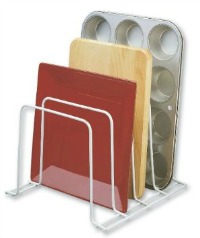
bakeware organizerOne of the simplest ways to do this is to think of your kitchen in terms of "zones" or areas of use. Then, make sure you keep the stuff close to where you'll use it. For example, pots and pans should be close to the stove, and the paring knife should be close to the kitchen sink and cutting board.
Here are some common kitchen zones you should consider using, and the items that should be in them. (Please note that there will be some overlap between zones so don't get too caught up in splitting zones up, versus what works for you. Further, your kitchen layout may not be ideal, so just do the best you can with what you've got. Just thinking it through can improve the space you've got to work in dramaticaly, even if it isn't "perfect" or doesn't exactly follow the rules below.)
Don't stack cutting boards and
cooking sheets for easier
access

Food Preparation Zone

The food prep zone is the area where you cut, chop, clean, mix, stir, etc. the food you are preparing. This area needs some open counterspace, and most likely will be close to the sink.
You should keep items such as your knives, cutting board, mixing bowls, mixers and blenders, measuring cups and spoons in this zone.

Cooking Zone

The cooking zone is where you do your cooking, either on the stove or in the oven (or microwave). It should therefore be close to these appliances.
You should keep items such as pots and pans, cooking utensils, potholders and bakeware in this zone.

Dishes And Dishwashing Zone

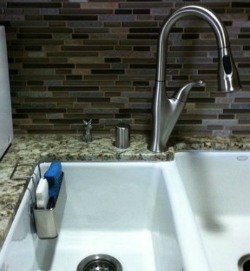
Simple Human sink caddy Simple Human sink caddy is an example of
keeping dishwashing zone organized
The dishes and dishwashing zone is the area where you keep your everyday dishes and eating utensils.
(Your good china and silver should most likely be stored elsewhere. Check out other portions of the 52 Weeks to an Organized Home Challenge for hints on storage for china, glassware and crystal and storing silver.)
This area should be close to the dishwasher and/or sink for ease of cleaning up and putting everything back away after use. You should also keep dishwashing supplies in this area, or in a sub-zone of this area, such as dish soap, sponges, dish cloths, etc.
Please note that if you've got children it is a good idea to have a special section, within their reach, for certain types of dishes, such as non-breakable cups or bowls so they can get themself a drink or water or a bowl of cereal for breakfast without your assistance. Trust me, it will save your sanity to have this easy access area for them, and will be worth the time invested in the whole Kitchen Cabinet Organization Challenge!
In addition, if you want your kids to set the table or put away dishes from the dishwasher, make sure they can reach these items without difficulty or you won't be able to assign them these chores.

Eating Zone

The eating zone should contain things you use on a regular basis for eating meals, such as tablecloths, napkins, salt and pepper shakers, serving bowls or platters, etc. It could also contain bibs for the baby.
Please note that the serving bowls and platters I'm referring to for this zone should be things you use regularly, not the ones you use only on special or holiday occassions.
Idealy the items for this zone should be stored close to the kitchen table, or dining room table, whichever you normally eat your meals at.

Food Storage Zone

We will focus on the food storage zone in the next couple of weeks of the challenge, so don't start tackling it just yet during the Kitchen Cabinet Organization Challenge this week. However, if you don't have a dedicated pantry, you may need to save some space in your cabinets or cupboards for some food storage so I mention it now just so you can keep it in mind.
Further, a non-food item that does belong near the food storage zone are the supplies you use for saving leftovers, such as aluminum foil, plastic baggies, and kitchen wrap, and you may wish to organize those types of items this week as well.
That concludes the main zones in the kitchen. Really think through where stuff should ideally go in your kitchen based on those zones and shift things around until they make sense, and fit in the space alotted. This step of the Kitchen Drawers and Kitchen Cabinet Organization Challenge is what will make your kitchen feel functional, and end up saving you a lot of time, since things will be easier for you to use when needed.
I also thought I would give special attention to three common areas in our kitchens that can be organizational challenges, so you can think through how you'll handle them as part of the Kitchen Drawers And Kitchen Cabinet Organization Challenge


****I am truly glad that I read this before I started the decluttering :) It makes throwing away and moving things a lot easier :)

Sunday, January 11, 2015

DECLUTTER - that is the name of the game Jan 11

Day 11 - Declutter potholders and kitchen towels
Today's declutter mission, for January 11, 2015, is to declutter kitchen towels, dish cloths, potholders and oven mitts. As usual, I'm not asking you to declutter them all, because after all we need to use some of them. But today's your day to get rid of any that are too stained, frayed, have holes, etc., or some if you have more then can fit easily into the space you have to store them in.


In addition, I would love to hear what you think a reasonable number of kitchen towels, dish cloths, potholders and such are for your home. I know this will vary per household for a variety of reasons, but your thoughts may help others who are struggling with how many to keep. I'd also like to hear how and where you store these items to give people ideas that might be more convenient then what they're currently doing.

****Here is my drawer after I sorted out the ones that were looking a little frayed.


Pot holders and dish rags
dish towels


Saturday, January 10, 2015

DECLUTTER - that is the name of the game Jan 10

Day 10 - Declutter everday tablecloths, napkins and placemats


****I keep my dish wash rags in the same spot as my pot holders and napkins and placemats.
As I only have 2 sets of placemats 1 is usually on the table while the other is in the hamper so I dont' have a real need to store them with this challenge I got rid of the ones that I was holding on to that didn't have a match anymore :) whoop whoop one more drawer

Monday, January 05, 2015

DECLUTTER - that is the name of the game Jan 5

Read Organized Home Challenge Week #1: Kitchen Counters

Organized Home Challenge


There are both obvious functions of a kitchen, and the sometimes unintended functions of a kitchen, because of its central location as a hub of family life. Here are some of the most common uses and functions. See which ones you use yours for:
Mine are highlighted in RED!!!

I have completed the 15 minutes of de-cluttering today by reading the organized home challenge at the top of this blog page. I am excited to see some progress!!!


Saturday, January 03, 2015

DECLUTTER - that is the name of the game Jan 3

Day 3 - Get in habit of making realistic daily to do list

http://www.home-storage-solutions-101.com/printable-to-do-list.html
Making and working from a to do list, daily, is something I highly recommend. It can keep you focused on your priorities and goals that you set for yourself, and over time it will allow you to actually begin to accomplish exactly the things you want to accomplish.
But to do lists only work if they're realistic. Otherwise they can be overwhelming and cause us to get discouraged and be counterproductive.

Make Your To Do List The Night Before

Each evening I suggest getting in the habit of making your to do list for the next day. It helps you get what you need to accomplish tomorrow out of your brain so you can just relax and rest for a while before you begin again the next day.
Making it the night before also allows you to think and plan, as opposed to reacting instinctively to the day's events and then spinning your wheels by not actually getting many useful things done.

Break Projects Into More Manageable Tasks

I used the example above of a project, "declutter your house." That is not something that I could get done in one day, how about you?
You see that written on your to do list and you ignore it, write it over and over on each day's new list, and/or just give up on that project because it seems unattainable.
However, you break it down into more manageable parts and tasks, like go through and declutter one drawer of your dresser today, and that doesn't seem too bad. Hmm, I could do that and then I get to check it off my list! Sweet!
If you're like me, I LOVE checking things off my list and so I actually enjoy breaking projects down because it eventually means more check marks. ;)
(And of course, for the decluttering project, I've actually already broken the project down into 15 minute missions for you, so just reference your calendar each day for your task!)

Make Your List Shorter If Possible

That being said, just because you should break your projects down into more manageable chunks doesn't mean that you should write 25, by themselves, managable tasks on your to do list for that day.
Add all of those tasks together and they aren't so realistic and managable anymore. You won't have time to do them all and that just leads to a feeling of failure.
I'm really bad about making my lists too long, so believe me, I often need to remind myself to practice what I preach, but I've found that when I do make a shorter list I am more likely to actually accomplish the things I have written down then if I write a longer list.
I've provided a free printable to do list template below, and it has 10 lines. That is the MAXIMUM number of things I think you should have on your daily list. Honestly, it would be better if you had five or less.

Create One List & Make Sure It's Placed For Easy Reference

Finally, to do lists won't do you any good if you can't find and reference them often during the day. So make one list, not just jotting things down on scraps of paper, and then place it somewhere you can look at it often.
Then, all day, you'll be able to track your progress and also re-focus yourself if you get off track.

*****what wonderful ideas .. a list with only 10 things I think that I can manage this one :) I will post a weeks worth of lists to make sure that I am sticking to only 10 things!!!
**** I can't seem to print the lists that are attached but what I did is get a 4x6 piece of paper and write 1 - 10 and at the end of each night before tim goes to bed we brainstorm what needs to happen the next day and write our list ... my problem is that I didn't finish the items from the list the day before do I transfer them to the new list ?????


Thursday, January 01, 2015

DECLUTTER - that is the name of the game in 2015

I want to get a handle on all the junk that is my life :) so snopping around pinterest today a post about de-cluttering your home and it only takes 15 min a day so I am thinking that I will start this tomorrow put I want to post what I should have done from the 1st until now :) so bare with me :)

here is the facebook page https://www.facebook.com/groups/882474821765361/
MISSION:
Today's de-cluttering mission, for January 13th, 2015, is to de-clutter your junk drawer. This is I know a lot of you have been mentioning as dreading this month, so let's all tackle it together today and bring chaos to the madness! Here's my article with ideas and inspiration for organizing your junk drawer today. or if you prefer pinterest
Pin it for later here --> http://www.pinterest.com/pin/148407750195034973/


I am publishing this as of Jan 1 but I didn't start the challenge until January 13